HashiCorp Vault Unveils Native AI Agent Security Controls
Breaking: HashiCorp Vault Adds First Native Security Layer for AI Agents
HashiCorp today announced a major update to its Vault platform, introducing native support for securing AI agents. The new capabilities—including an agent registry, granular identity-based policies, and per-request ephemeral authorization—aim to address the unique security challenges posed by autonomous, non-deterministic AI workflows.
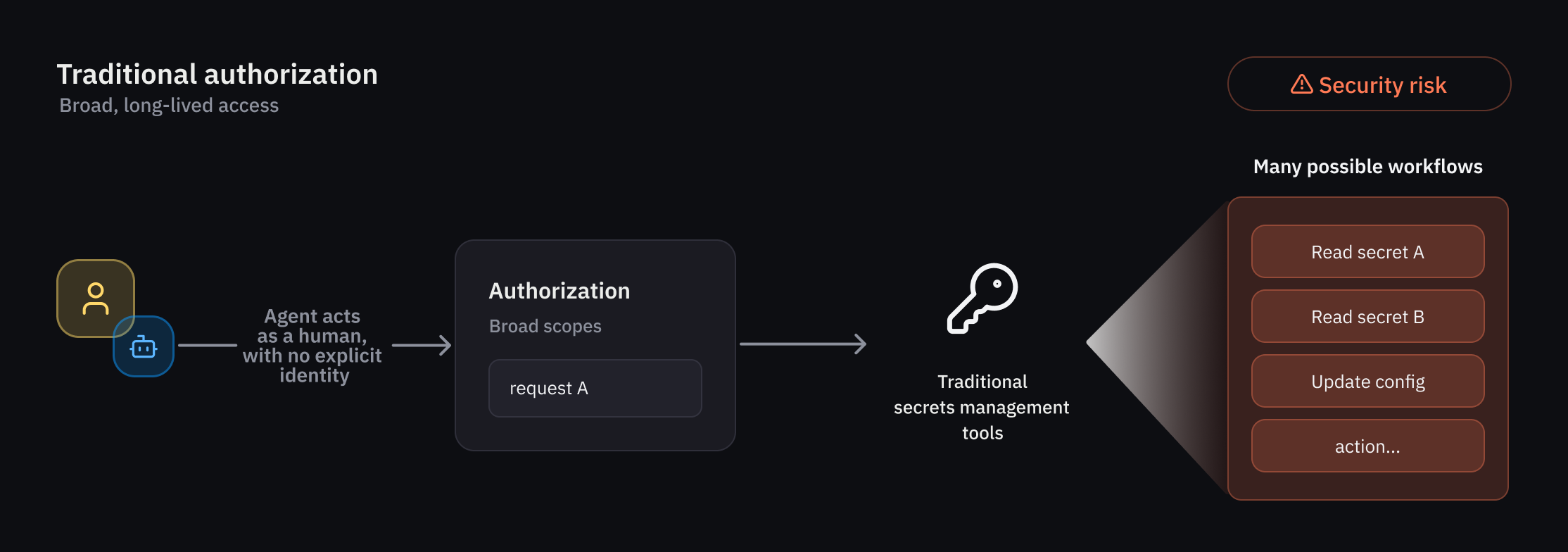
“Traditional IAM was built for deterministic users and scripts, not for agents that make decisions in real time,” said [Spokesperson Name], HashiCorp’s VP of Product Security. “With these new primitives, organizations can enforce guardrails specific to agent behavior, ensuring every action is temporary, scoped, and auditable.”
Agent Registry: A New Identity Primitive
Vault now includes an agent registry that allows developers to register and manage AI agents separately from human and traditional non-human identities (NHIs). This separation is critical for delegation flows, such as when an agent acts on behalf of a human user using an on-behalf-of (OBO) pattern.
“The registry forms the foundation for a dedicated framework of registration, authorization, credential management, and observability,” the company stated. Delegation and consent are explicitly tracked, providing clear attribution for actions performed by agents.
Granular Identity-Based Policies for Least Privilege
Because agent behavior can be non-deterministic, Vault applies deterministic guardrails through a rich set of policy-based runtime controls. Administrators can define per-request access rules that evaluate trust across multiple dimensions, especially when agents operate in delegation mode carrying a human user’s authority.
“Least privilege is even more critical when the actor is an autonomous agent,” noted [Expert Name], an identity security analyst at [Firm]. “Vault’s approach ensures that even if an agent deviates from expected behavior, it cannot access secrets beyond the scope of its current task.”
Ephemeral Authorization: Reducing Risk with Time-Bound Access
Vault introduces per-request authorization controls that grant temporary access rights expiring after a specific task or timeframe. This ephemeral authorization mechanism reduces the risk of credential abuse by ensuring that tokens are short-lived and tightly scoped to a particular transaction context.
“AI agents require more than static permissions; they need authorization that maps closely to their identity and the specific request context,” HashiCorp explained. The ephemeral approach aligns with zero-trust principles, minimizing the attack surface even in dynamic agent workflows.
Background: Why AI Agents Demand a New Authorization Model
Traditional identity and access management (IAM) was designed for deterministic users and workflows—humans following step-by-step procedures or scripts with predictable outcomes. AI agents, however, are autonomous, non-deterministic actors that require a fundamentally different authorization model that combines identity, delegation, runtime policy evaluation, and ephemeral access.
As organizations adopt AI agents for tasks ranging from code generation to system administration, HashiCorp Vault customers increasingly requested controls specifically for autonomous systems. Key needs included: enforcing guardrails for unpredictable agent behavior, fine-grained runtime authorization, clear attribution of agent actions performed on behalf of users, and a standardized approach to securing agents across environments and workflows.
What This Means: A New Standard for Agentic Security
Vault’s native AI agent support represents a significant step toward making agentic workflows secure at scale. By providing an agent registry, granular identity policies, and ephemeral authorization, organizations can now deploy AI agents with confidence, knowing that their security posture adapts to the non-deterministic nature of agent behavior.
“This is a game-changer for companies that are integrating AI agents into production environments,” said [Analyst Name], a senior analyst at [Research Firm]. “Until now, the security tooling for agents was an afterthought. HashiCorp is treating agent identity as a first-class citizen.”
The capabilities are currently in early access with select customers, and a broader public beta is planned for summer 2025. Organizations interested in participating can sign up on the HashiCorp website.