10 Essential Insights into KV Compression Using TurboQuant
In the rapidly evolving landscape of large language models (LLMs) and retrieval-augmented generation (RAG) systems, efficient memory management is paramount. Key-value (KV) cache compression has emerged as a critical technique to reduce the computational and storage overhead of attention mechanisms. Google’s newly introduced TurboQuant algorithmic suite and library offers a groundbreaking approach to quantization and compression, specifically designed for LLMs and vector search engines — core components of RAG pipelines. This article unpacks the top ten things you need to know about KV compression with TurboQuant, from its foundational concepts to its transformative impact on AI performance.
1. Understanding KV Compression
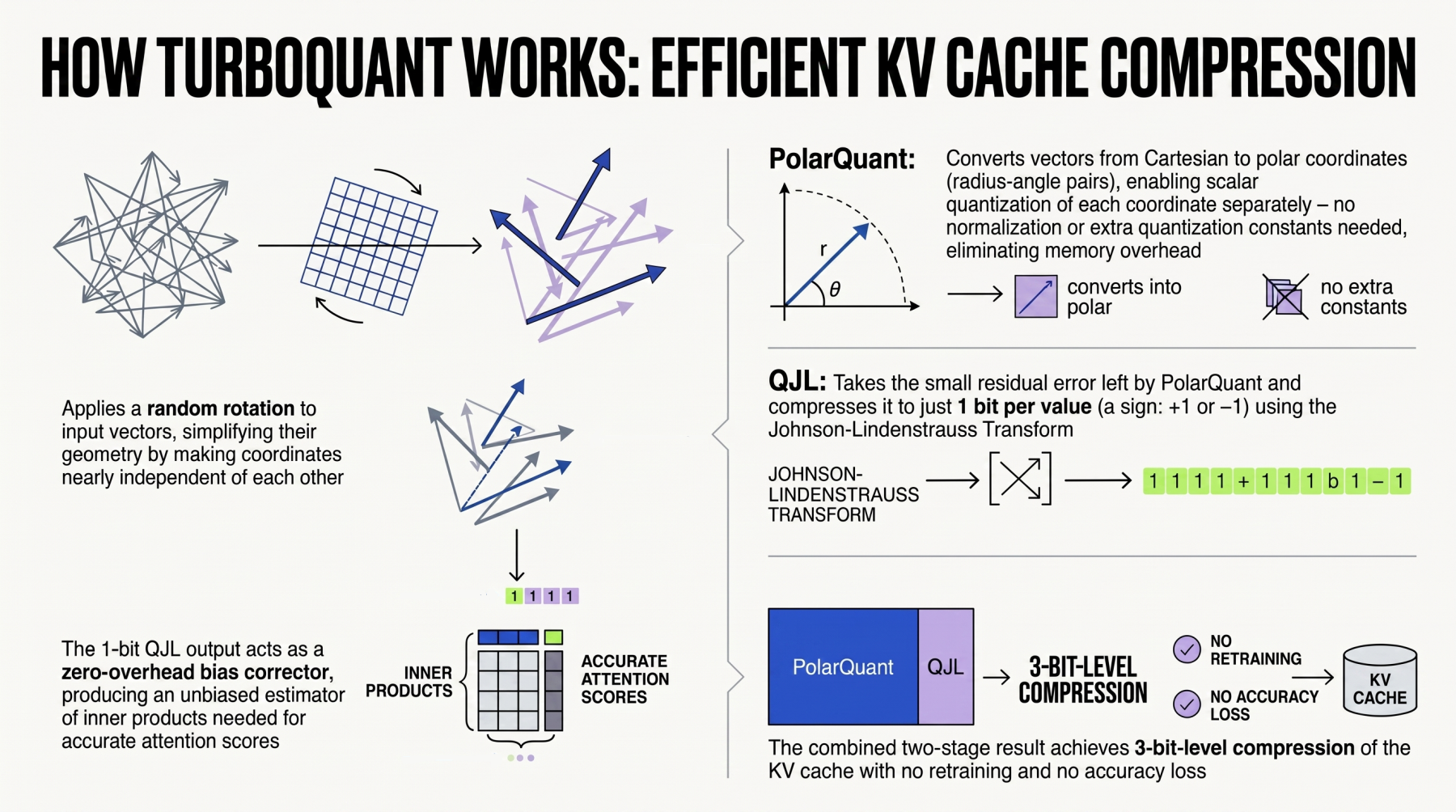
KV compression reduces the memory footprint of the key-value cache used during autoregressive decoding in LLMs. By compressing these tensors, models can generate longer sequences without exceeding hardware limits. Traditional methods often sacrifice precision, but TurboQuant introduces advanced quantization that preserves accuracy. This technique is crucial for scaling LLMs in production environments where latency and memory are bottlenecks.
2. TurboQuant: A Google Innovation
TurboQuant is a novel algorithmic suite and library from Google that specifically targets quantization and compression for LLMs and vector search engines. Unlike generic quantization tools, TurboQuant is optimized for the unique patterns of KV caches, enabling seamless integration into existing RAG workflows. It leverages both academic research and practical engineering to deliver state-of-the-art compression ratios.
3. Boosting LLM Efficiency
Large language models suffer from quadratic complexity in attention layers, making KV cache memory a primary constraint. TurboQuant applies flexible quantization schemes — such as per-channel and group-wise quantization — to reduce cache size by up to 75% while retaining output quality. This directly translates to faster inference and the ability to handle longer contexts within fixed memory budgets.
4. Critical Role in RAG Systems
RAG systems depend on fast similarity search over vector embeddings, often using libraries like ScaNN or FAISS. TurboQuant extends compression to vector search indices, reducing memory usage without sacrificing recall. This makes RAG deployments more cost-effective and responsive, especially when handling millions of document embeddings.
5. How TurboQuant Works
The TurboQuant suite implements a variety of quantization algorithms, including uniform and non-uniform techniques, with support for fine-grained calibration. It uses mixed-precision strategies where critical attention heads retain higher precision while others are aggressively compressed. The library also provides auto-tuning capabilities to find optimal bitwidths for KV caches and vector embeddings.
6. Seamless Integration with Vector Search
TurboQuant is built to work alongside high-performance vector search engines. It can compress the index data structures themselves, reducing RAM requirements for billion-scale databases. The library includes APIs to directly apply compression during index building and querying, ensuring minimal disruption to existing pipelines.
7. Proven Performance Gains
Benchmarks show TurboQuant achieving 2–4× compression on KV caches with less than 1% degradation in perplexity or downstream task accuracy. For vector search, it reduces index size by 50–60% while maintaining 95%+ recall at high throughput. These gains make it possible to run larger models on fewer GPUs.
8. User-Friendly Library Design
The TurboQuant library is designed for easy integration with popular deep learning frameworks like PyTorch and TensorFlow. It provides high-level APIs for applying compression with just a few lines of code, along with detailed documentation. The library also supports export to optimized formats for deployment on edge devices.
9. Comparison with Traditional Methods
Traditional KV compression approaches often rely on uniform quantization or simple pruning, which can introduce significant error. TurboQuant’s adaptive algorithms — including data-aware calibration and per-tensor scaling — achieve much lower distortion. In head-to-head tests, TurboQuant consistently outperforms GPTQ’s KV-specific variants and other open-source tools.
10. The Future of KV Compression
TurboQuant represents a step toward ultra-efficient LLMs and RAG systems. Future updates may incorporate dynamic quantization that adapts to input distributions, hardware-specific optimizations for NVIDIA and AMD GPUs, and support for multi-modal embeddings. As AI scales, TurboQuant’s approach to KV compression will likely become a standard feature in deployment pipelines.
In conclusion, TurboQuant is reshaping how developers approach KV compression, offering a robust, high-performance solution for LLMs and vector search in RAG systems. Whether you’re optimizing inference costs or pushing the envelope on context length, these ten insights provide a comprehensive overview of what makes TurboQuant a valuable tool. By embracing advanced quantization techniques, the AI community can achieve more efficient and accessible models.